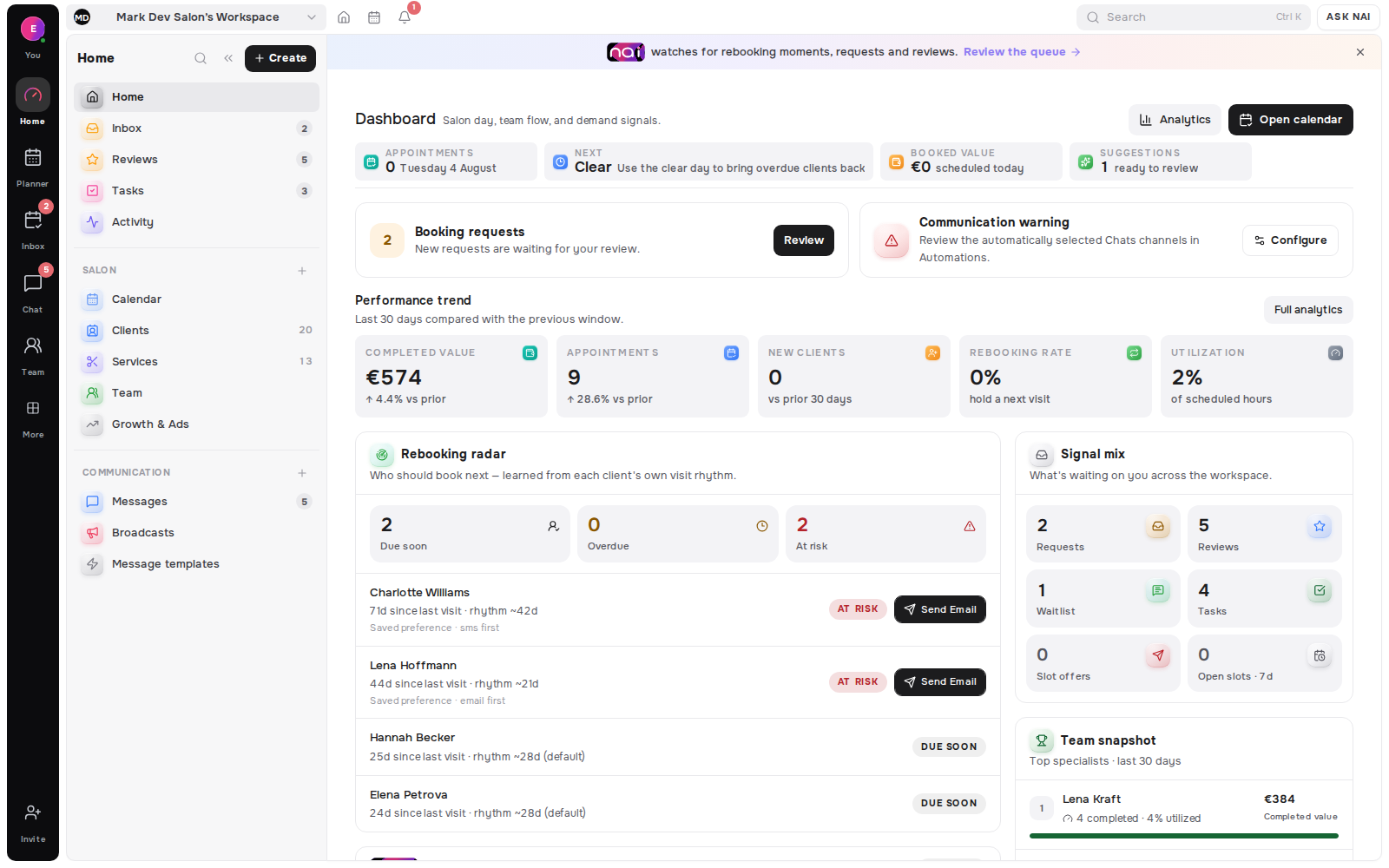
There are two messages here and people keep merging them. The appointment reminder goes out about a day before a booking that already exists, and the research on that window is unusually clear. The rebooking message goes out when a client passes their own normal gap between visits, which is a different clock and rarely a round number of weeks. Send both on the same schedule and one of them will always be wrong.
The reminder protects a booking. The rebooking message asks for one. Mixing them is why so many "retention campaigns" feel like nagging.
Key takeaways
- Two messages, two clocks: the reminder runs on the appointment, the rebooking message runs on the client.
- A day before is the well-tested reminder window, and the channel matters far less than the timing.
- SMS and a phone call produce nearly the same attendance. One of them costs about forty times more.
- Rebooking timing comes from each client's own interval, not from a monthly campaign date.
- A cooldown is not a limitation. It is the setting that keeps the whole loop credible.
Two messages, two clocks
The appointment reminder is a service message. Something is booked, the client agreed to it, and you are protecting it from being forgotten. Its clock is the appointment.
The rebooking message is a request. Nothing is booked, and you are asking for time and money. Its clock is the client's own rhythm - four weeks for one person, six months for another.
Everything downstream follows from that split. The reminder can be automatic, uniform and frequent, because it refers to a commitment the client already made. The rebooking message cannot, because it does not.
The reminder: about a day before, and the channel barely matters
The best single trial on this is unusually clean. In a randomised non-inferiority study at Geneva University Hospitals, 6,450 patients received a reminder 24 hours before the appointment. Missed appointments came in at 11.7% (randomised non-inferiority trial, 2013) for text messages against 10.2% (same trial) for phone calls - a gap of 1.5 points that did not reach significance.
Then look at what each one cost over the same period. Text messages totalled €230. Telephone reminders totalled €8,910, of which €8,700 (2013 trial) was administrative labour.
That is the whole argument in two numbers. A person on the phone is slightly better and roughly forty times more expensive, so the sensible default is an automated message a day ahead, with calls reserved for the appointments you genuinely cannot afford to lose.
The broader literature agrees on direction. Across 29 studies, median non-attendance fell from 23.1% (systematic review, 2011) to 12.5% (same review) once reminders existed, at an average of €0.41 per reminder.
The rebooking message: timed to the client, not to the month
Most retention tools send on a calendar. First Tuesday of the month, everyone who has not been in for six weeks, one template.
That produces two errors at once. A client whose normal gap is four weeks gets contacted three weeks late, by which time they have already booked elsewhere. A client whose normal gap is six months gets contacted four months early, and learns that your messages are not about them.
The fix is the same one that makes the queue work at all: take the median gap between that client's own past visits, and treat "days past it" as the trigger. We set the mechanics out in how to know which client should book next, and the wider loop in the client who comes back.
Two guardrails matter more than the exact day. A client with a future booking should never enter the queue. A client contacted recently should sit in a cooldown until it expires.
| Message. | Clock it runs on. | Sensible default. | What breaks it. |
|---|---|---|---|
| Appointment reminder. | The appointment. | About 24 hours before. | Sending so early it is forgotten again. |
| Confirmation request. | The booking event. | Immediately, then with the reminder. | Asking twice in one hour. |
| Rebooking message. | The client's own interval. | Shortly after they pass it. | A monthly campaign date. |
| Win-back. | Days overdue, well past the interval. | Once, then stop. | Repeating it every month. |
Speed matters most right after something goes wrong
If a client misses an appointment, the useful window is short and the effect is large.
A prompt message after a no-show brought patients back within thirty days 22.2% (randomised clinical trial, 2024) of the time, against 11.6% (2024 trial) for the standard letter alone. Roughly double, from being quick rather than from being clever.
Recall messages to people who are simply due behave differently - real, and much smaller. A trial of 4,115 adolescents moved preventive visits from 59% (reminder/recall trial, 2013) to 65% (same trial) with mailed reminders, a number needed to treat of 17.
Plan for both honestly. The miss-recovery message is your highest-yield message of the month. The due-date message is a steady one-in-seventeen nudge, which is worth sending and is not a growth strategy.
Book the return close
Whenever the conversation succeeds, put the appointment near.
Across 46,655 appointments, no-shows ran at 9.1% (lead-time analysis, 2015) inside a two-week horizon and 38.3% (same analysis) at six months. A rebooking message that lands on a date four months out has done half a job.
What this looks like in Belom
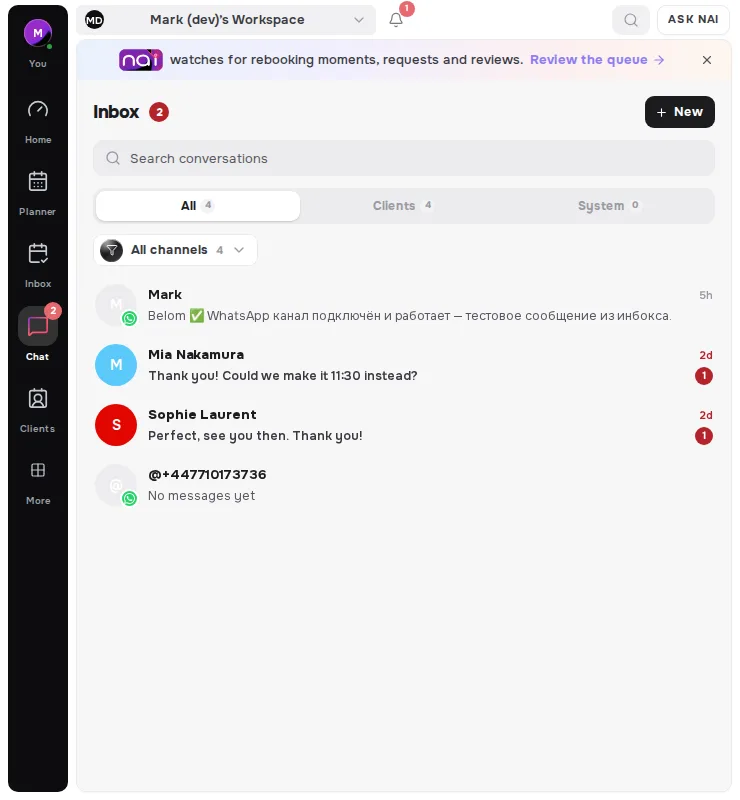
The two clocks are separate settings, on purpose. Appointment reminders run from the booking. Rebooking signals run from the client's own interval. Every signal passes the same filters before it can become a message. A future booking removes it, recent contact holds it, consent and opt-outs override it, and a daily cap bounds the whole thing.
The cooldown is the part worth defending in an argument. It is what stops a good system from turning into the monthly blast it was built to replace.
[ORIGINAL DATA] The one number the vendors do not print
Methodology. On 19 August 2026 we searched the public documentation and feature pages of six booking platforms. We looked for a stated reminder lead time: any concrete "we send it N hours before", or a documented selectable range. Sample size: six vendors, public pages only, one pass, no accounts. We recorded only what the pages state in writing.
Not one readable page publishes a lead time.
Square's help article on confirmations and reminders tells you to "select a time frame prior to the scheduled appointment" and never says what the choices are. It does document one behaviour precisely: "If a customer hasn't confirmed their appointment by the time a reminder is scheduled, the confirmation request will be resent with the reminder message".
Square's marketing page is titled "Free SMS & Email Appointment Reminder Software" and states no timing at all.
Fresha's automated-notification pages returned a shell with no documentation body to a non-browser request, twice. Mindbody, Acuity and Booksy returned errors or HTTP 403 and are marked unverified rather than described.
| Source. | Lead time stated. | What it does state. |
|---|---|---|
| Square help article. | No. | Confirmation requests are resent with the reminder. |
| Square reminder feature page. | No. | Channels only. |
| Fresha notification pages. | Not retrievable. | Page shell only, twice. |
| Mindbody · Acuity · Booksy. | Unverified. | Error or HTTP 403. |
[UNIQUE INSIGHT] Set that against the literature and the asymmetry is striking. The research names its window every time - 24 hours in the Geneva trial, days rather than hours in the recall studies - because the number is the intervention. The vendors describe channels, templates and toggles, and leave the one variable that decides whether any of it works as an unlabelled dropdown. The practical consequence is that reminder timing is almost never a decision in a salon; it is a default nobody chose, inherited from a settings screen. If you take one action from this article, open that dropdown and look at what it currently says. It is the cheapest number in your business to get right, and almost certainly the least examined.
Definitions used in this article
An appointment reminder is a service message about a booking that already exists, such as a note the day before a Tuesday appointment.
A confirmation request is a reminder that also asks the client to confirm, which lets you release the slot early if they do not.
A rebooking message is a request sent when a client passes their own normal gap, for example three weeks after a four-week client was due.
Cooldown is the minimum time between two messages to the same client, and it is what keeps a system from feeling like a campaign.
Booking horizon is how far ahead the returning client is booked, which changes attendance rather than just convenience.
FAQ
When should an appointment reminder be sent?
About a day ahead is the best-tested window. A trial of 6,450 patients used 24 hours and reported missed-appointment rates near 10–12% (2013 non-inferiority trial) for both channels tested.
SMS or a phone call?
SMS, for almost everything. The same trial found the two within 1.5 points of each other while the phone option cost €8,910 against €230.
Is a monthly rebooking campaign fine?
No. A calendar date is late for short-interval clients and early for long-interval ones, so the same send produces two different errors.
How soon after a no-show should I write?
Quickly. A prompt message roughly doubled thirty-day return against a standard letter (2024 trial).
How often is too often?
Set a cooldown and respect it. Unanswered messages are information about timing; three in a fortnight is a reason to be muted.
Should reminders be automatic?
Yes, they refer to a commitment the client already made. Rebooking messages should start manual or assisted, because they ask for a new one.
Where this fits
The queue this message comes from is set out above, and the full loop in the client who comes back. The measurement definitions are in rebooking rate vs client retention. Which channel the client actually reads is a stored field, covered in what a waitlist has to store, and keeping those channels in one place is in one inbox for WhatsApp, Instagram, Telegram and SMS.
The timing side of this in Belom is the rebooking radar.
Editorial note: written by the Belom product team from how the product actually works, not from vendor marketing. More about Belom, or contact us with a correction. Reviewed 19 August 2026.