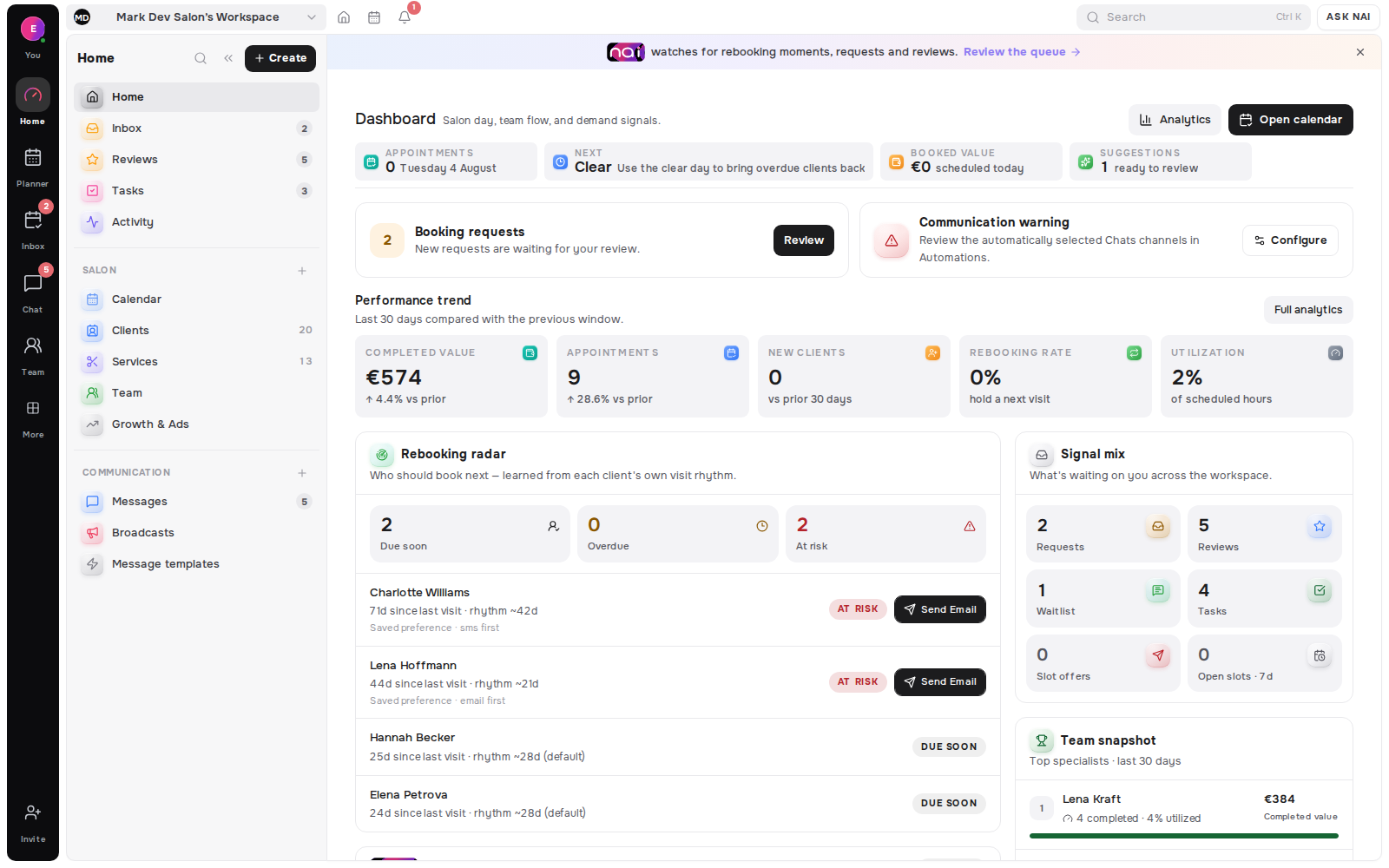
Rebooking is a timing problem, not a message problem. The system that works starts from completed visits, learns each client's own gap between returns, filters that signal against future bookings, recent contact and consent, and only then produces a message. Send enough reminders and some clients will return. Send the right reminder to the right person at the right moment and far more of them will, at a fraction of the volume.
The more useful question comes earlier than the message: which client is likely to need which service again, and when is the conversation actually timely?
Belom starts with completed visits. It keeps those visits beside the client record, learns the return pattern when enough evidence exists and turns that timing into a practical signal. The message is the last step, not the system.
Key takeaways
- Rebooking is decided by timing and evidence. The message is the last step, not the system.
- Cadence comes from a client's own completed visits, not from one fixed interval applied to everyone.
- "Due" is a raw date. It becomes an opportunity only after future bookings, recent contact and consent have filtered it.
- Reminder effects in the research are real and modest, such as one extra visit per seventeen letters, so plan for a nudge rather than a transformation.
- Start in manual or assisted mode. Automate only once the queue is trustworthy.
Client memory is the foundation
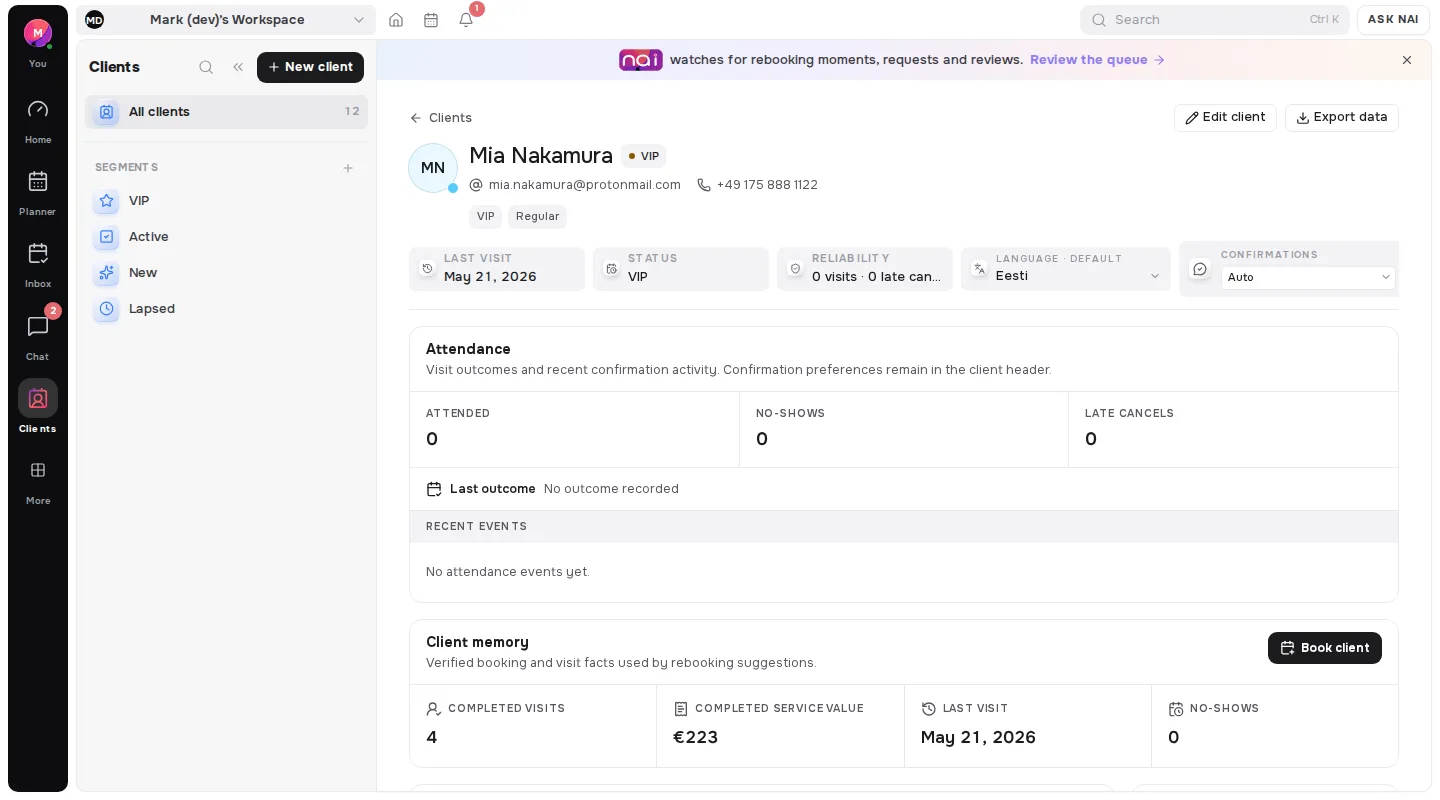
A return signal is only as useful as the history behind it. Belom keeps services, completed visits, preferences, notes, conversations and future bookings attached to the same owner-scoped client record.
That connected record answers the questions a generic campaign list cannot:
- What service did this client complete?
- When did it happen?
- Have they returned for the same service before?
- Is another visit already booked?
- Has someone contacted them recently?
- Which language and available channel fit the relationship?
- Has the client allowed marketing outreach?
The point is not to collect more data for its own sake. The point is to avoid asking the client to repeat context and to stop irrelevant outreach before it starts.
Cadence comes from completed visits
Belom groups a client's completed visits by service and looks at the gaps between returns. Repeated service history can reveal a personal cadence instead of forcing every client into one fixed reminder interval.
A single visit is not enough to calculate a personal pattern. During early history, Belom can use the configured rebooking interval for the service. If that is not available, the workspace default provides a starting point. The timing becomes personal only after completed return visits create real gaps.
Different services can have different rhythms for the same client. That matters because a client may return frequently for one service and only occasionally for another. One blanket reminder rule would flatten those relationships into the same schedule.
Cadence is a signal, not a guarantee. It indicates when a return conversation may be useful. It does not claim to know why a person has or has not booked.
The mechanics of ranking that list are set out in how to know which client should book next.
Due does not automatically mean contact now
Timing needs guardrails. Before a client reaches the active chase list or an automatic reminder is allowed, Belom can account for facts that make outreach unnecessary or inappropriate.
A future booking should keep the client out of the rebooking queue. Recent contact should trigger a cooldown. Marketing consent and client opt-outs must be respected. The owner decides which channels are available and how much outreach can happen in a day.
These checks turn a raw date into a more useful opportunity:
- A completed visit supplies the service and timing evidence.
- Repeat history or a configured interval supplies the expected return window.
- Future bookings, recent contact and consent rules filter the signal.
- Due, overdue and at-risk relationships become visible in Rebooking Radar and Today's Opportunities.
- A person or an enabled rule decides what happens next.
That sequence is the difference between relationship follow-up and a blind blast.
| Stage. | What supplies it. | What it protects against. |
|---|---|---|
| Evidence. | Completed visits with service and date. | Guessing who is due. |
| Window. | Personal cadence, or the service interval as fallback. | One interval flattening every client. |
| Filter. | Future bookings, cooldown, consent, opt-out. | Contacting people who are already booked. |
| Decision. | A person, or a rule the owner enabled. | Automation running ahead of trust. |
What the evidence actually says about timing
Beauty has little published data on returns, but missed appointments and recall have been studied for decades in healthcare, and four findings transfer directly.
Reminders work, modestly. A review of 29 studies found median non-attendance falling from 23.1% (systematic review, 2011) to 12.5% (same review) once reminders were introduced. The average reminder cost €0.41 (2011 review), with SMS and automated calls at €0.14 and manual calls at €0.90 per patient.
Recall works, and the effect size is small. In a randomised trial of 4,115 adolescents, preventive visits reached 65% (reminder/recall trial, 2013) with mailed reminders against 59% (2013 trial) for the control group. That is roughly one extra visit for every seventeen letters, which is worth doing and is not a transformation.
Speed after a miss matters more than volume. A prompt message after a no-show brought patients back within thirty days 22.2% (randomised clinical trial, 2024) of the time, against 11.6% (2024 trial) for a standard letter.
A return booked far ahead decays. Across 46,655 appointments, no-shows ran at 9.1% (lead-time analysis, 2015) inside a two-week horizon and 38.3% (same analysis) at six months. A separate analysis of 332,281 transactions found nonarrival rising about 16% (scheduling horizon analysis, 2020) per extra 30 days of horizon.
Put together, these say something specific. A rebooking system should aim to produce a small number of well-timed conversations that end in a near-term booking, rather than a large number of messages that end in a distant one.
Choose the level of control you want
Not every business wants the same operating mode. Belom separates the signal from the sending decision.
Manual mode keeps the radar and opportunity queue visible without preparing or sending outreach. Open the client record, review the context and write when the moment feels right.
Assisted mode prepares outreach for review. You can change the wording, choose the channel and decide whether to send.
Automatic mode can send within the limits you set. Consent, opt-outs, cooldowns, future bookings, channel choices and daily limits still apply.
Marketing can also be disabled on an individual client record. The workspace may allow rebooking outreach while one relationship remains excluded.
A reminder should sound like the relationship
When outreach is appropriate, the most useful message is usually small. It can reference the relevant service and last visit, use the client's saved language and offer a clear next step.
Email is the base channel for automatic retention outreach. SMS or a connected messaging channel can sit alongside it when available and enabled. Belom follows the saved channel preference where possible, but the owner keeps the channel settings.
Avoid turning a return reminder into a long promotion. The goal is to reopen a useful conversation, not to prove how much the system knows.
Review the signal as part of the morning
Rebooking works best when it is not another report you remember to open once a month. Belom can place due and overdue relationships in Today's Opportunities beside other practical actions for the day.
The workflow stays close to the client:
- Scan the most relevant return signals.
- Open the client record and recent context.
- Check whether the timing and service still make sense.
- Send or approve a personal reminder when appropriate.
- Put the confirmed return back into the planner.
Over time, completed return visits become new cadence evidence. The next signal is informed by what actually happened, not only by the original service default.
[ORIGINAL DATA] The rebooking reminder has been an open request since 2021
Methodology. On 19 August 2026 we searched the public help documentation and public feature-request boards of six booking and salon platforms. We looked for one documented feature: a reminder that asks a client to book again, timed from their last visit rather than from an upcoming appointment. Sample size: six vendors, public pages only, one pass. We quote only text printed on the vendor's own site.
We did not find such a feature documented as shipped by any of them. We did find it requested.
On Square's public ideas board, a salon owner asked for exactly this in January 2021. The request reads: "it would be amazing if Square has the ability to auto send out rebooking reminder (with a booking link is a bonus), at a set time frame from the initial appointment". Two days later a Square moderator replied that they had "not heard of any plans to change how these email notifications work on Appointments", and suggested similar functionality might eventually arrive through Square Marketing. No timeline was given.
The thread now sits on the board titled "Archived Ideas (Read Only)". Its status is still "New".
| Signal. | What we found. |
|---|---|
| Shipped feature documented. | None found across six vendors. |
| Public request. | Square ideas board, 15 January 2021. |
| Vendor response. | No plans; possibly via a marketing product later. |
| Current state of the thread. | Archived, read-only, status "New". |
[UNIQUE INSIGHT] The detail worth keeping is where the answer pointed. The moderator did not say the idea was wrong; they redirected it to the marketing product. That redirection is the whole industry position in one sentence. A reminder tied to an upcoming appointment is treated as scheduling and ships in the base product, because it protects a booking that already exists. A reminder tied to a past visit is treated as marketing and gets sold separately, because it is assumed to be promotion. But the second one is not promotion. It is the operational question of whether a relationship is still running, and filing it under marketing is what makes it optional, consent-gated by default and quietly dropped from most calendars. Five years in an archive with the status "New" is not neglect of a small feature. It is a category error about which part of the business rebooking belongs to.
Definitions used in this article
Rebooking is the act of a completed visit producing a next booking, whether it happens at the counter or weeks later after a reminder.
Cadence is a client's own typical gap between returns for one service, such as four weeks for maintenance and six months for a one-off.
A due signal is a raw date saying a client has reached their expected return window, before any filtering is applied.
An opportunity is a due signal that has survived the filters, for example a client with no future booking, no recent contact and valid consent.
Assisted mode means the system prepares outreach and a person approves it, which is the safe default until the queue is trustworthy.
FAQ
Is rebooking just sending more reminders?
No. Volume is the least useful lever. The evidence puts reminder effects in the single-digit percentage-point range (2013 reminder/recall trial), so the gain comes from timing and relevance, not frequency.
How many visits before the cadence is personal?
Two return gaps give a rough pattern and three give a usable one. Before that, the configured service interval is the honest fallback, and the signal should be shown as an estimate.
Should a client with a future booking be contacted?
No. A future booking is the strongest possible filter, and letting it through is the fastest way to make clients distrust every message you send.
Manual, assisted or automatic?
Start manual, move to assisted once the queue looks right, and automate last. Automation inherits every error in your data and repeats it daily.
How far ahead should the return be booked?
As close as the client will accept. Attendance falls measurably as the horizon grows (2015 lead-time analysis), so a return booked four months out is worth much less than the same return booked in three weeks.
What if the client does not respond?
Record the attempt and let the cooldown run. An unanswered reminder is information about timing; three unanswered reminders in a fortnight is a reason for the client to stop reading you entirely.
Where this fits
The definitions and formulas behind the numbers are in rebooking rate vs client retention. Ranking the queue is covered in how to know which client should book next. When the answer is that nobody can book because the calendar is full, the page-side fix is in what your booking page should show when there are no free times. Confirmed returns land back in the planner.
Editorial note: written by the Belom product team from how the product actually works, not from vendor marketing. More about Belom, or contact us with a correction. Reviewed 19 August 2026.