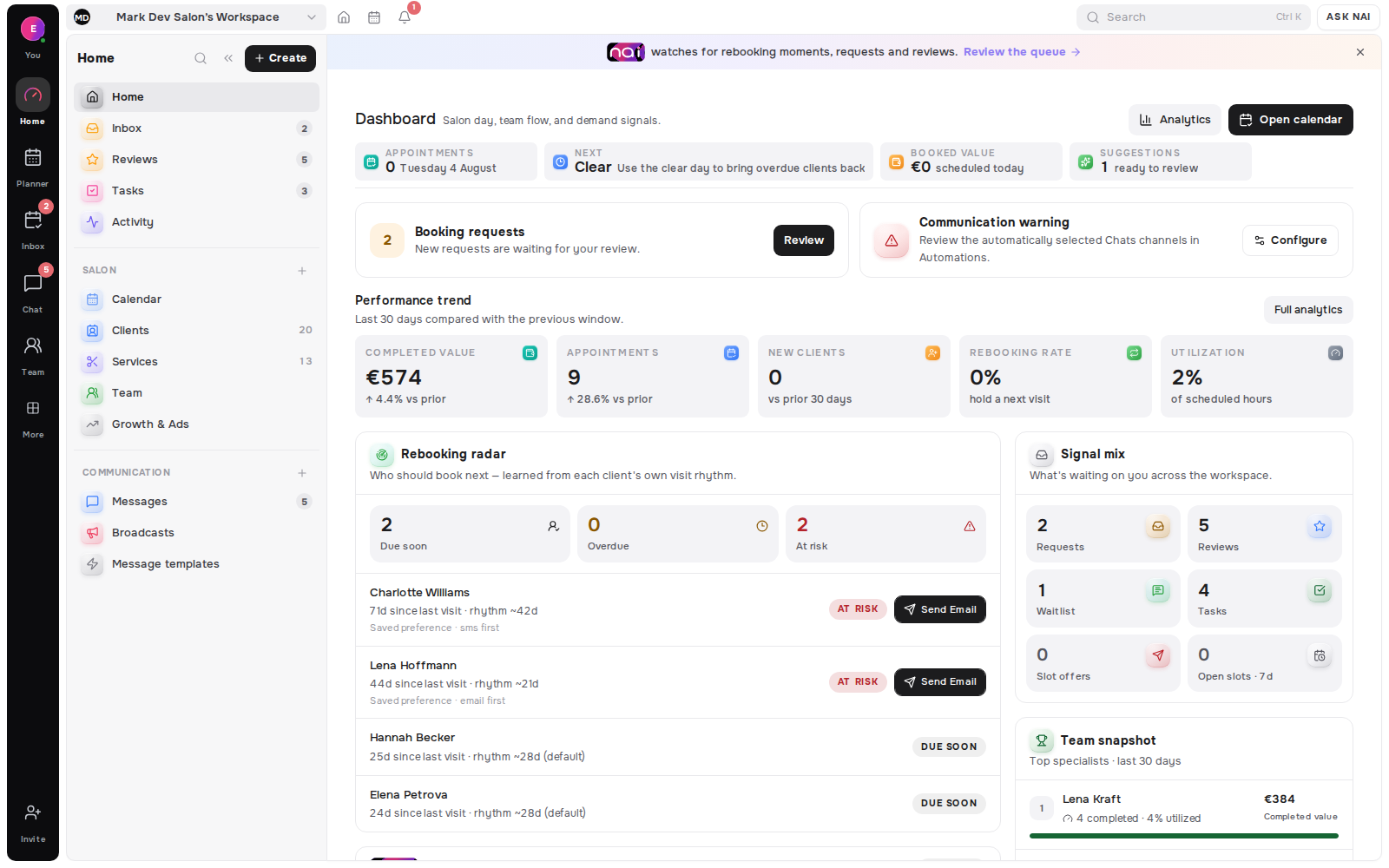
Show one exact price wherever the work is predictable, use "from" only where it genuinely varies and say what changes it, and never show nothing. That is not a preference - it is what the market already does. Across 2,030 services on 62 real salon booking pages, 1,589 carried a single exact price and only 47 used a range. The interesting group is the 394 that showed no price at all, because that is the choice clients read as a warning.
The debate usually gets framed as protecting your margin. On the page it reads as something else entirely.
Key takeaways
- Exact price is the norm, not the brave option: 1,589 of 2,030 services in our sample used one.
- "From" is honest only when you also name what moves the number, such as hair length or removal.
- Showing nothing costs you the client who was comparing two pages and could only price one.
- The salon-wide "price range" is not a price. In our sample the median catalogue spanned 11 times from cheapest to dearest.
- Price belongs in the price field rather than in the service name, which is what keeps it correct on the day you change it.
What the three options actually mean
An exact price says the work is predictable and you have done it enough times to know. It is the strongest signal of competence anywhere on the page, and it removes the only question that the client cannot answer for themselves.
A "from" price says the work varies, and it commits you to a floor. It is honest when the variation is real and named, and evasive when "from" is quietly doing the job of "we will tell you at the till".
A range says much the same thing with two numbers instead of one, and it is rarer than people assume. In practice it works only when the two ends sit close enough together to be a decision rather than a shrug.
No price says nothing at all, so clients fill the silence themselves, and usually with a number rather higher than your own.
When "from" is honest and when it is evasive
The test is a single sentence: can you name the thing that moves the price, in words that the client can apply to themselves without asking?
"From €60, depending on hair length" is honest - the client knows which side of it they are on. "From €60" alone is not, because the client cannot tell whether they will pay €65 or €160, and a person who cannot estimate their own bill often does not book at all.
The same applies to removal, to extra length, to a second colour, to travel. Name the variable and the "from" becomes genuinely useful, whereas leaving it unnamed publishes a number that only protects you.
| Format. | Says to the client. | Use when. |
|---|---|---|
| Exact price. | This is predictable and I know it. | The work varies little. |
| From, with the variable named. | It depends on this specific thing. | Length, removal or add-ons change it. |
| From, with nothing named. | I would rather not say. | Never. |
| A range. | It lands between these two. | The ends are close enough to decide on. |
| Nothing. | Ask me. | Only for genuine bespoke work. |
The services with no price
In our sample 394 services carried no price of any kind. That is close to one service in five.
Some of those are legitimately bespoke, such as tattoo work sized by the piece or treatment plans set after a consultation. Most are not: they are ordinary services on a page where somebody never finished filling in the catalogue.
The cost is invisible, which is exactly why it persists: a client comparing two salons can price one of them, so they book that one, and you never learn that the comparison happened at all.
There is a second cost that shows up later. An unpriced service produces a booking made on an assumption, and when the assumption is wrong the appointment gets cancelled and rebooked further out, where attendance is measurably worse. Reminders recover part of that, but only part: across 29 studies median non-attendance fell from 23.1% (systematic review, 2011) to 12.5% (same review), which still leaves one booking in eight unattended. Across 46,655 appointments, no-shows ran at 9.1% (lead-time analysis, 2015) within two weeks and 38.3% (same analysis) at six months.
The salon-wide price range is not a price
Almost every page in our sample published a catalogue-level range, in the form of a currency and two numbers.
It is close to useless, because the median catalogue in our sample spanned 11 times from its cheapest service to its dearest, and the widest we found ran from 10 to 12,000 in the same currency. A summary that says "somewhere between a small add-on and a full day" is not information a client can act on.
Treat it as a by-product of your catalogue rather than a message, because the number that actually matters sits on the individual service.
[ORIGINAL DATA] How 2,030 real services are priced
Methodology. On 19 August 2026 we parsed the JSON-LD offer catalogue of the same 62 salon booking pages audited in what an online booking page needs. The pages were drawn deterministically from Fresha's public salon sitemap. For each service we recorded whether the markup carried a single price, a low and high price that differ, or neither. Sample size: 2,030 services across 62 catalogues, one platform, server-rendered markup only.
| Pricing shown on the service. | Count, out of 2,030. |
|---|---|
| One exact price. | 1,589. |
| A range, where low and high differ. | 47. |
| No price of any kind. | 394. |
Sixty of the 62 pages also published a catalogue-level price range, always as a currency followed by a minimum and a maximum. Their spread from cheapest to dearest had a median of 11 times. Thirty-seven of the 60 spanned at least 10 times, 20 spanned at least 25 times, and 13 spanned at least 50 times. Thirty-nine services were priced at zero.
[UNIQUE INSIGHT] The ratio of 1,589 to 47 is the finding, and it is the opposite of the advice usually given in this industry. The received wisdom is that publishing an exact price is risky and a range keeps you flexible. In practice the range is a rounding error - fewer than one service in forty uses one - and the flexible option that actually gets used is silence, which 394 services chose. So the real choice on a live page is not exact versus range. It is exact versus nothing, and nothing is the one option that transfers the whole problem to the client at the exact moment they are comparing you with someone who answered. The businesses that look confident are not the ones with the best prices. They are the ones whose page can be read without asking a question.
What to do
- Price every service you are willing to sell, even approximately.
- Use "from" only where you can name the variable in the same line.
- Move any bespoke work into a consultation service with its own price.
- Keep the price in the price field, never in the service name - only 9 of 2,030 names carried one, and a price written into a name goes stale the day you change it.
- Ignore the catalogue-level range. It is a by-product, not a message.
Definitions used in this article
An exact price is a single number attached to one service, such as €45 for a gel manicure.
A "from" price is a stated floor, and it is only honest when the variable that moves it is named in the same sentence.
A price range is a low and a high figure on the same service, which works when the two ends are close enough to decide between.
A catalogue-level price range is the minimum and maximum across everything you sell, and it is a by-product rather than a price.
Bespoke work is work genuinely priced after a conversation, which belongs in a consultation service rather than an empty price field.
FAQ
Should I show prices on my booking page?
Yes. In our sample 1,589 of 2,030 services showed an exact price, so a page without one now reads as evasive rather than flexible.
Is a range better than an exact price?
Rarely. Only 47 services out of 2,030 used one, and a range only helps when both ends are close enough for the client to decide.
When is "from" acceptable?
When you name the variable in the same line, such as "from €60, depending on hair length". A bare "from" leaves the client unable to estimate their own bill.
What if the work is genuinely bespoke?
Sell a consultation with its own price. That converts an unanswerable question into a bookable service.
Should the price go in the service name?
No. The price has its own field that stays correct when you change it, and a name carrying a stale number is worse than no number.
Is the salon-wide price range useful?
Not really. The median catalogue in our sample spanned 11 times from cheapest to dearest, which is too wide to act on.
Where this fits
The full page checklist is in what an online booking page needs, and how to write the text under each price is in how to write a service description. The build order for a first version is in set up your booking page in one evening.
The pricing modes described here live in the Belom service catalog.
Editorial note: written by the Belom product team from how the product actually works, not from vendor marketing. More about Belom, or contact us with a correction. Reviewed 19 August 2026.