A full calendar should never be the end of the page. When there are no free times, show the next date that actually exists. Offer a waitlist that records what the client wants rather than just their phone number. Offer another specialist or a shorter service where that genuinely fits. Then say plainly how and when you will get back to them. The client arrived ready to book. The only question is whether the page keeps them.
Most booking pages are designed for the good case. Someone opens the link, sees a grid of times, picks one. The case nobody designs is the one that costs the most: someone opens the link, wants to pay you, and finds nothing.
Key takeaways
- A full calendar is not a neutral state - it is where a ready-to-book client either survives or leaves.
- Replace "no availability" with the next real date, a waitlist that stores preferences, and a plain sentence about what happens next.
- A waitlist entry must carry the service, specialist, date range, time range and acceptable notice. Names and phone numbers cannot be matched to a slot.
- Offer an alternative only when it is genuinely equivalent - for example another specialist who actually performs that service.
- Never send the client back into your inbox, and never discount to fill a gap.
"No appointments available" is a dead end you built
An empty grid with no next step reads as closed. Not busy - closed.
The client has three options at that moment, and two of them are bad for you. They can write to you, which turns a self-service booking into a conversation you have to manage. They can come back later, which almost nobody does. Or they can open the next specialist's link, which is what most of them do, because they came to solve a problem this week and not to admire your popularity.
The cost is invisible in a way that makes it easy to ignore. A cancelled appointment leaves a hole you can see in your calendar. A client who bounced off a full week leaves nothing at all.
Show the next date that actually exists
The first fix is the cheapest. If this week is full, do not show an empty week - show the first day that has real availability, and let the client move there in one action.
This changes the sentence the page is saying. "No appointments available" is a refusal. "Next available: Tuesday, 2 September" is an offer. Same calendar, opposite outcome.
It also filters honestly. A client who needs an appointment in three days now knows immediately and can decide, instead of messaging you to find out and waiting for a reply.
A waitlist needs preferences, not a phone number
Most waitlists fail because they are a list of names. A name tells you nothing when a slot opens on Thursday at 14:00 and you have eleven people on the list.
A waitlist entry becomes useful when it records what you would otherwise have to ask:
- which service the client wants.
- which specialist, or whether any is fine.
- the earliest and latest dates that work.
- the time range that works - morning, afternoon, evening.
- how short a notice they can accept.
- how to reach them.
With those fields, a slot that opens at 09:00 for a 14:00 appointment is matched against people who said they can move on the same day, not broadcast to everyone. Without them you are back to messaging eleven people and managing the replies.
The last field matters more than it looks. A client who can only take two days' notice is not a bad waitlist entry - they are a good one for cancellations that happen early, and a wasted message for cancellations that happen at lunchtime.
Offer an alternative only when it is real
Two alternatives are worth showing, and both have a condition.
Another specialist, when they genuinely perform the service and their result is comparable. A client sent to someone who cannot do what they booked is worse than no alternative at all.
A shorter or adjacent service, when it solves the client's actual problem. Someone who wants maintenance may accept a shorter appointment this week and a full one next month. Someone who wants a first application usually cannot.
What is not worth showing is a discount. A full calendar is not a demand problem, and discounting to fill it teaches your best clients to wait for the gap.
Say what happens when a slot opens
This is the part that turns a waitlist from a form into a promise, and most pages skip it.
The client should know three things before they submit: that they will be contacted directly when something matching opens, roughly how quickly they will need to respond, and that the slot goes to whoever confirms first. That last point is not harsh - it is the thing that makes the whole system fair and fast, and stating it up front prevents the argument later.
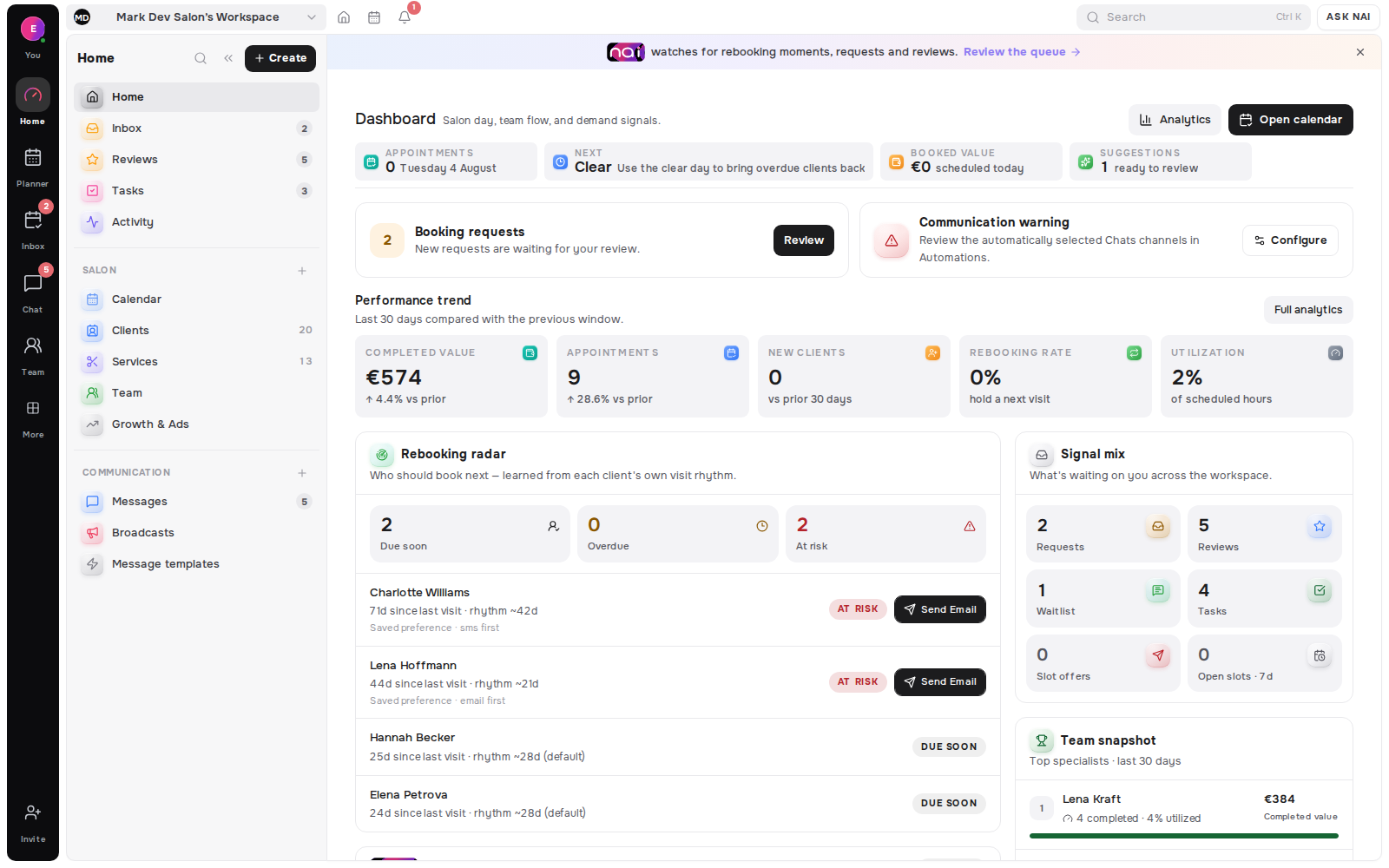
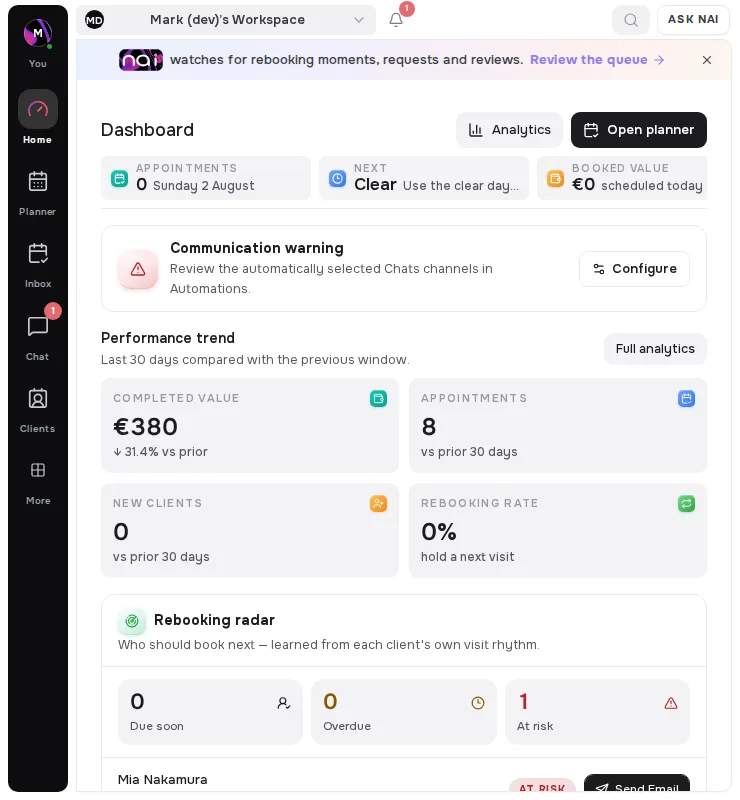
In Belom this is the loop the Opportunities side of the product exists for. A cancellation does not just leave a hole in the calendar; it produces a matching offer to a specific client, sent through their own channel, with a link that either confirms or expires. The offer is targeted rather than broadcast, so the client who accepts is one who already told you that day and time works.
That is also why the waitlist fields are not bureaucracy. They are what makes the offer land on the right person instead of eleven.
Do not ask people to write to you
"DM me for availability" undoes the booking page.
It moves a solved problem back into your inbox, at the exact moment you are busiest - because your calendar being full is precisely when you have the least time to negotiate times by message. It also removes every rule the booking flow was enforcing: duration, service, notice period, cancellation terms.
Keep messaging for the cases that genuinely need a human: an unusual request, a client who cannot tell which service they need, an accessibility question. Everything else belongs in the flow.
What the client should see, in order
- A clear statement that this specific week is full - not a blank grid.
- The next date with real availability, one click away.
- A waitlist that asks for service, specialist, date range, time range and acceptable notice.
- An honest alternative, only where one exists.
- A plain sentence about what happens next and how fast they need to answer.
- A way to reach a human for genuinely unusual cases, placed last rather than first.
Handled well, a full calendar stops being a leak and becomes the start of the return loop - the same loop that decides who gets invited back and when, which we wrote about in the client who comes back. The numbers behind that loop are set out in rebooking rate vs client retention, and what to actually do in the first fifteen minutes after a cancellation is in how to fill a last-minute cancellation.
If your page serves clients in more than one language, this empty state is the one most often left untranslated, and it is the worst one to leave in a language the client does not read. We covered how to handle that in multilingual booking page in Estonia.
Does any of this actually change behaviour?
Beauty has little published data, but missed appointments have been studied for decades in healthcare, and three findings transfer directly.
A booking far in the future decays. Across 332,281 scheduling transactions, nonarrival rose 16% (scheduling horizon analysis, 2020) per extra 30 days of horizon in specialty practice, 11% (same analysis) in primary care, and passed 50% (2020 data) once the horizon exceeded 90 days.
The moment after a miss is recoverable. In a randomised trial, a prompt message after a no-show brought patients back within 30 days 22.2% (randomised clinical trial, 2024) of the time against 11.6% (2024 trial) for the standard letter alone.
And offering a freed slot works, but only at scale with matching. One health system sent 60,660 short-notice offers over nine months and 11% (self-rescheduling cohort study, 2024) were accepted - enough to add 2,576 service hours, and a reminder that broadcasting produces far more misses than hits.
FAQ
What should a booking page say when nothing is free?
Name the constraint plainly - this week is full - then give the next real date, a waitlist that records preferences rather than names, and one sentence on how and when you will be in touch.
Should I ask people to message me instead?
No. It moves a solved problem back into your inbox exactly when you have the least time, and it drops every rule the booking flow was enforcing: duration, service, notice period, cancellation terms.
Is a discount a good way to fill a gap?
No. A full calendar is not a demand problem. Discounting to close a gap teaches your best clients to wait for the next gap.
How far ahead should I open bookings?
Far enough that regulars can plan, not so far that bookings decay. Attendance falls measurably as lead time grows (scheduling horizon analysis, 2020), so an unlimited horizon is not a neutral choice.
What if the waitlist never fills anything?
Check the entries before blaming the idea. A list of names cannot be matched against a Thursday 14:00 opening; a list carrying service, date range, time range and acceptable notice can.
[ORIGINAL DATA] What the platforms actually promise the waiting client
Methodology. On 19 August 2026 we tried to retrieve the official waitlist documentation of eight booking platforms with a standard HTTP client. Three pages returned content and are quoted below; the help centres of Booksy, Vagaro and Acuity answered 403 to non-browser requests, so their behaviour is excluded rather than guessed. Sample size: three platforms, documentation only - we did not observe live booking pages.
Within that sample, the three vendors give the waiting client three different promises.
Fresha is sequential and says so: notifications go out when a time opens, and "the next client in line will be notified if the previous client doesn't book within the set timeframe". The client is told they are in a queue.
Mindbody documents two modes - Auto-add, which "moves waitlisted clients to the roster as spots open, based on when they joined the waitlist", and First to Claim, which "texts waitlisted clients as spots become available, adding the first to respond". One is a queue, the other is a race, and the client experience differs completely.
Square gates the waitlist to Plus and Premium subscriptions. It also adds a rule the others do not document, for instance as a guard against over-messaging: "we won't notify your customers about a new opening if we've already notified them in the past six hours".
| Platform. | Who gets the freed slot. | Notes. |
|---|---|---|
| Fresha. | Next client in line; moves on if they do not book in time. | Sequential by design. |
| Mindbody. | Auto-add by join order, or first to respond. | Two modes, opposite client experience. |
| Square. | Notified clients, suppressed if messaged in past six hours. | Waitlist limited to Plus and Premium. |
| Booksy · Vagaro · Acuity. | Not verified. | Help centre returned 403 to a standard client. |
[UNIQUE INSIGHT] That six-hour suppression rule is the most useful line in the whole sample. Nobody builds a throttle for a system that sends few messages - it exists because broadcasting openings to everyone who might want them produces message fatigue fast enough to need a guard. The lesson for a booking page is not that waitlists are noisy; it is that the promise you show the client has to match the policy behind it. Tell someone they are in a queue when they are actually in a race, and the first missed slot costs you the relationship, not just the appointment.
Definitions used in this article
The empty state is what your booking page shows a client when no times are available - the screen most pages never design.
A waitlist is a record of which service, specialist, date range and time range a client will accept, not a list of names and phone numbers.
Waitlist fill rate is the share of cancelled slots that were filled from the waitlist rather than left empty.
Acceptable notice is the shortest warning a client says they can act on, and it is the field that decides whether a same-day opening can be offered to them at all.
The Belom surface for this loop is the empty-slot matcher, which turns a freed slot into a targeted offer.
Editorial note: written by the Belom product team from how the product actually works, not from vendor marketing. More about Belom, or contact us with a question. Reviewed 19 August 2026.